
Eclipse Teamwork

After months of preparation, eclipse observers only had a few short minutes to perform the many tasks expected of them. Popular accounts of these dramatic events celebrated British mastery of astronomy, imperial greatness, and the observers’ superiority over native populations. But records and reports from eclipse field sites reveal a more complicated picture of colonial fieldwork.
An eclipse party portrait
This photograph, and the notes recorded on its reverse, capture the observing team at Pulgaon, India, shortly after the eclipse of 22 January 1898. Pride of place is given to the astronomers and their travelling party, seated.
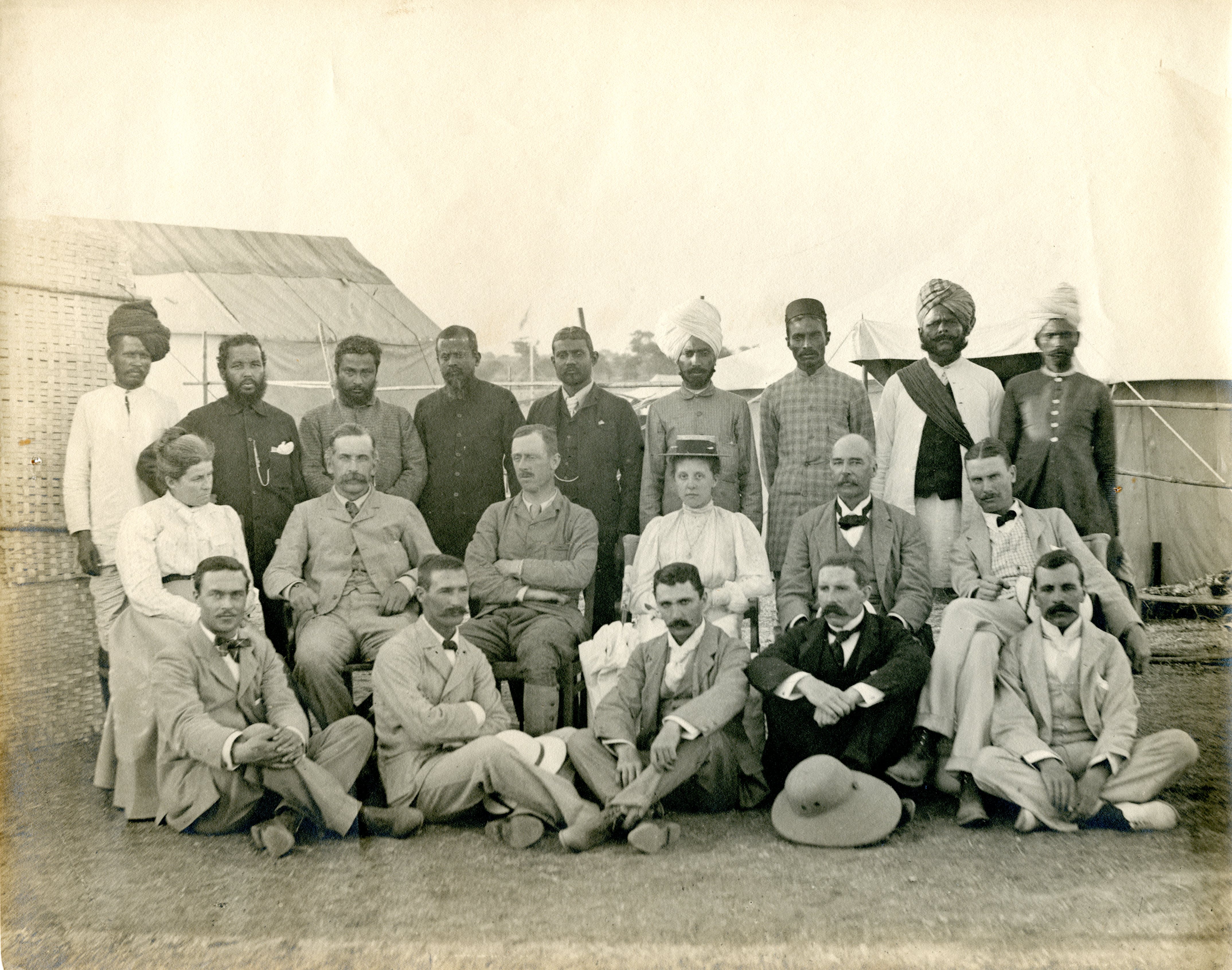
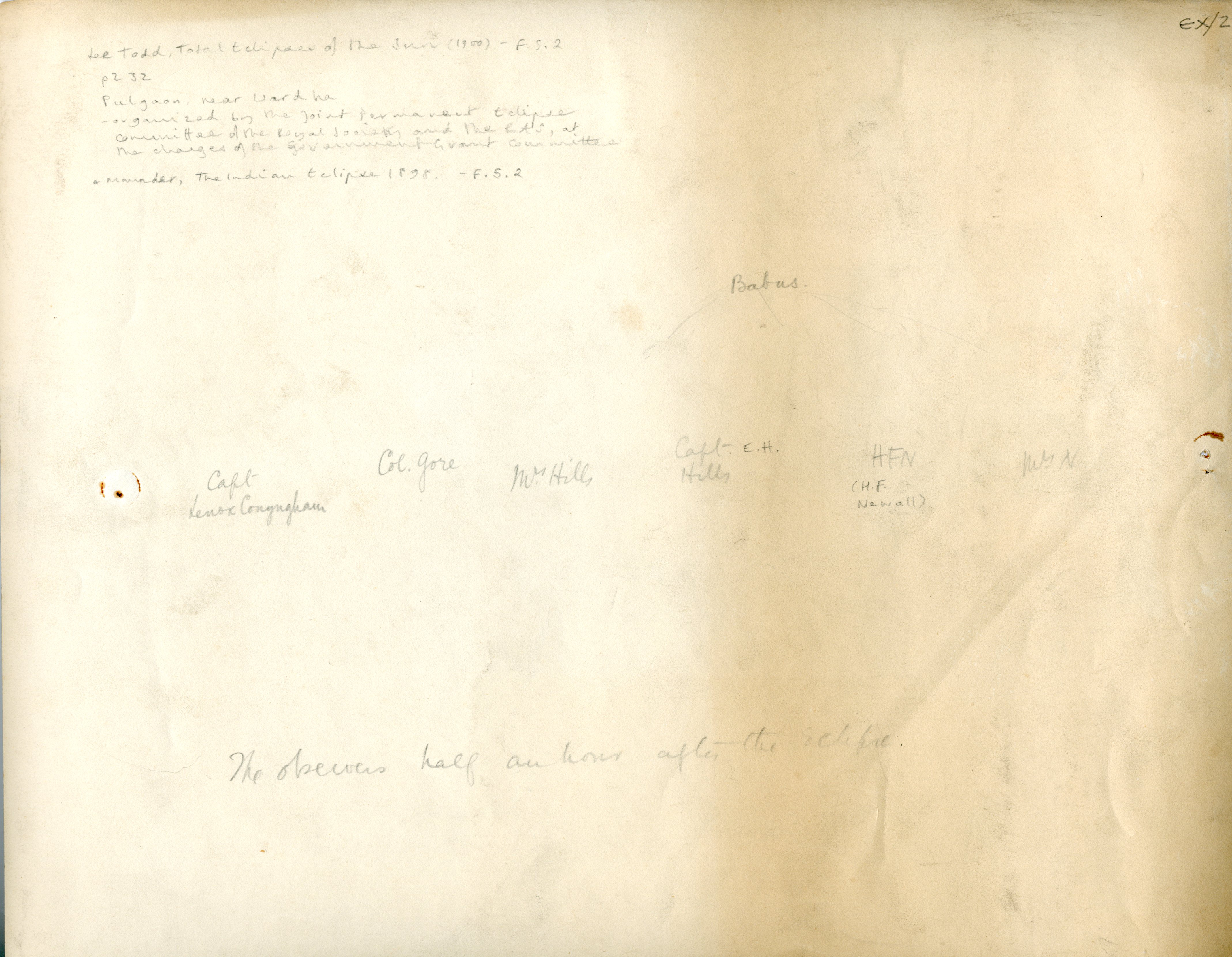
On the ground in front are three Royal Engineers and two members of the Imperial Civil Service. Standing behind are nine assistants, marked collectively as “Babus”, the title given to native Indian clerks.
The expedition’s leaders, Captain Hills and H. F. Newall, reported that “The skilled native assistants, provided by the kindness of the Surveyor-General, were thoroughly accustomed to observing work, and the preparations and preliminary drill proceeded with the utmost smoothness.”
Observing totality
During totality, an observing party was a whirlwind of carefully orchestrated activity.
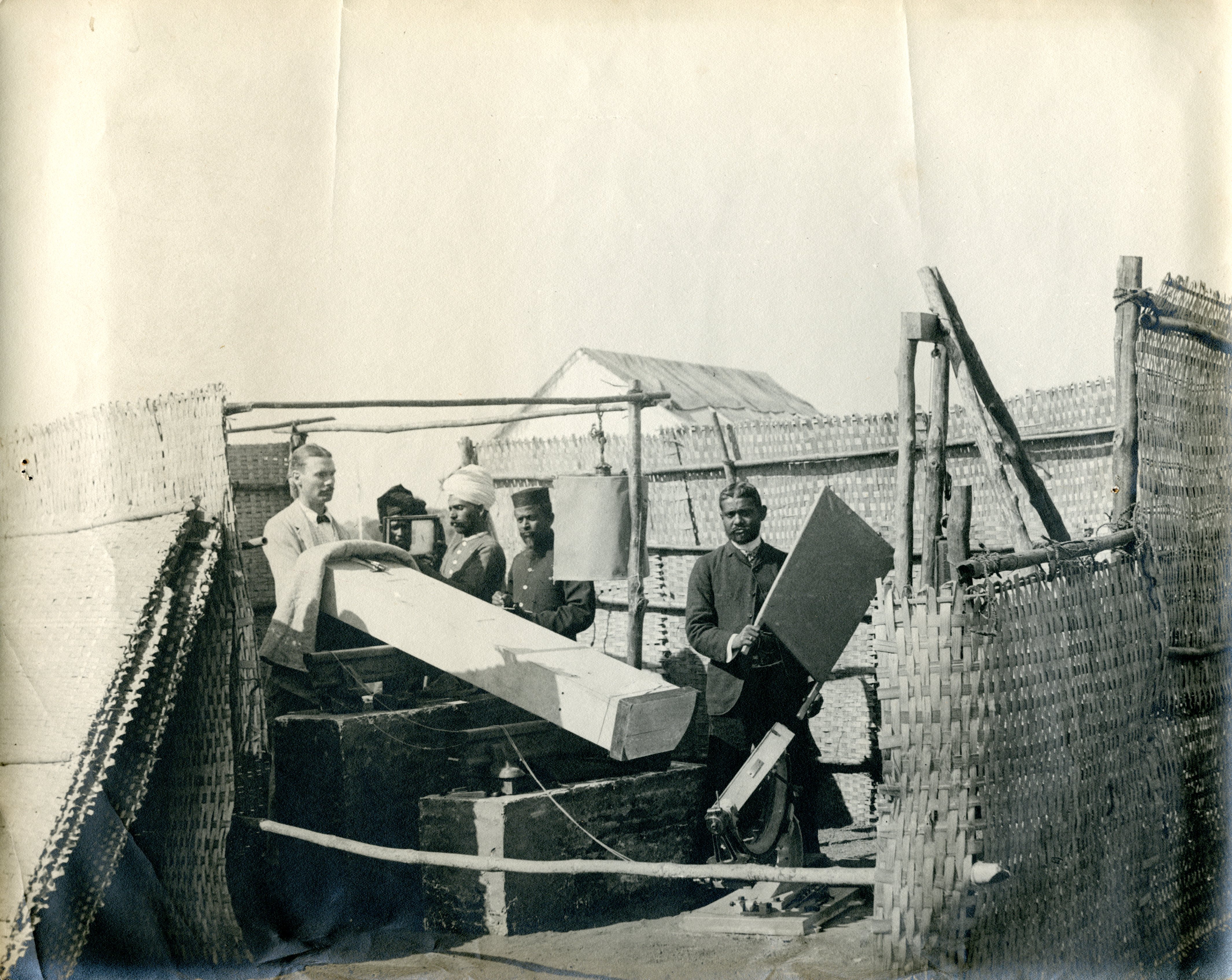
Elapsed time was called out from the beats of a metronome (Image 1); temperature changes were recorded; strictly drilled teams exposed a succession of photographic plates; and senior astronomers observed the eclipse directly, drawing and dictating observations.
As astronomer Norman Lockyer recollected of an eclipse observed in India in 1871:
“There is strict silence in the fort, and the work of recording the … phenomena visible in telescope, spectroscope, and polariscope … goes on like clockwork; but it is very different below.
'The natives see in the eclipse their favourite god devoured by the monster Rahoo … Yells, moans, and hideous lamentations rend the air.”(1)
Native prejudices
As Lockyer’s quote (above) makes clear, eclipse observers were quick to draw distinctions between their own exacting work and the superstitions of their hosts.
Once astronomers returned to Britain their public reports often contrasted European observers’ rationality with what they saw as the primitive beliefs of locals—even those who had successfully assisted them. Accounts like this of the Astronomer Royal William Christie reinforced British notions of intellectual superiority and colonial difference:
“The natives of India regarded [the eclipse] as a very solemn religious function, and we were somewhat nervous as to whether our native assistants—who were high-caste Brahmins—might not fall down on their knees and begin to say their prayers, instead of attending to the duties they were told off to perform.
'I am very glad, however, to bear testimony that they performed their duties most satisfactorily and managed to reconcile duty and religion … I mention this as one of the things that cause some anxiety to observers during an eclipse, and to show that native ideas and native prejudices must be reckoned with.”(2)
References
1.J. Norman Lockyer, Contributions to Solar Physics (London: Macmillan, 1874), pp.343–44.
2.William H. Christie, public lecture, ‘The Photography of the Recent Total Solar Eclipse’, May 1898.
Joshua Nall
Joshua Nall, ‘Eclipse Teamwork’, Explore Whipple Collections, Whipple Museum of the History of Science, University of Cambridge, 2020.